


The Personal SWOT: A Tool to Discover Your Hidden Strengths

There was a time when I felt stuck in someone else’s mold. I believed I had to match my peers’ paths—same job title, same “success” metrics, same lifestyle. I saw their strengths clearly; my own were blurry. One evening, exhausted and feeling like an impostor, I took a long walk to clear my head. Why do I seem stuck by my own weaknesses? Why are other sprinting ahead in life, but I feel left behind?
And something shifted: What if I view my weaknesses not as a curse, but just unfinished parts of myself? And what if I stop trying to be good at everything but rather become brilliant at the times that make me, me.
That shift was the start of my own Resourceful journey
The Resolute Life teaches us that before you can optimize your time, money and health, you need to clearly understand how you can optimize these resources. And the secret behind this how lies in self-awareness awareness. One of the most practical tools for this purpose (and that is why it is still used across the world), is The Personal SWOT framework. the SWOT (Strengths, Weaknesses, Opportunities, Threats) is a framework—not just for companies, but for every person wanting to live with Intent. It helps you know what you already hold, and what you can still grow into. In the book The Daily Life of Resolute Beings - Be Resourceful, we have adapted this framework to create the Resolute SWOT Matrix - A powerful tool of self-awareness and resource optimization.
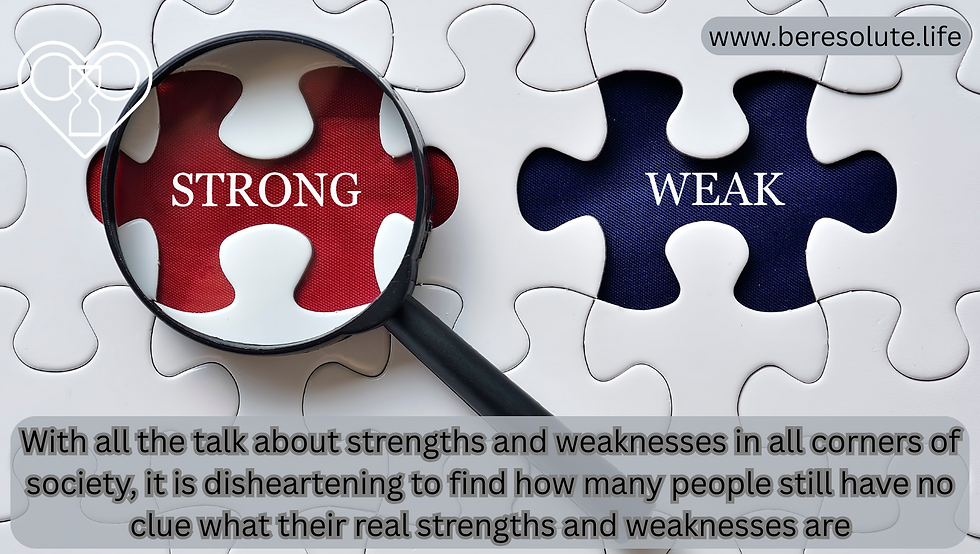
What is a Personal SWOT and Why It Matters
At its core, a SWOT analysis is about facing reality with courage. It strips away illusions and invites you to look at yourself in four dimensions: the good, the hard, the possibilities, and the risks. Though simple, it is powerful because it gives language and structure to things you may only feel vaguely.
Strengths are your assets: abilities, character traits, talents, relationships, past victories.
Weaknesses are your gaps: what holds you back, where you tend to stumble.
Opportunities are external openings: emerging trends, spaces others neglect, relationships waiting to be built.
Threats are external risks: what circumstances, culture, market, or changes could undermine what you want.
When you map these honestly, you stop hiding behind comparison or excuses. Instead, you begin to see your life as a balance of resources and challenges you can actively work with.
What Research Says
Research highlights why the Personal SWOT works so well. Studies consistently show that people who take the time to reflect systematically make sharper choices, manage risk better, and step into opportunities more confidently.
A review of SWOT methodology shows that its power lies not in lofty vision, but in honest assessment—especially naming threats early, before they cause harm (ResearchGate).
According to MindTools, roughly 80% of people who complete a personal SWOT feel more confident about making targeted career and life decisions. Clarity reduces hesitation and boosts action.
The NHS Improvement toolkit notes that even a basic SWOT forces people to scan their environment—to see opportunities and risks that otherwise would have remained invisible. That external awareness lowers risk and increases adaptability.
Psychologist Daniel Kahneman’s work on cognitive bias reinforces the importance of SWOT: without tools like this, people overestimate strengths, underestimate weaknesses, and ignore threats. Structure helps overcome bias.
Taken together, these findings remind us: a SWOT done thoughtfully is not self-criticism—it is self-illumination.
How Tamarin Discovered Her Strengths—and Rewrote Her Path
Stories often show what frameworks can’t. So let me tell you the story of Tamarin. Tamarin, a mid-career teacher, thought she had only one strength—hard work. She assumed her weaknesses defined her and believed opportunities were scarce in her environment. Threats like burnout and budget cuts loomed large.
Then she tried a personal SWOT, asking people around her for honest feedback. What she learned reframed her life.
Strengths: Others saw her empathy, her ability to build safe spaces, and her quiet leadership.
Weaknesses: Her inability to set clear boundaries and speak-up lies behind the reason she needs to work so hard.
Opportunities: She noticed after-school associations needing leaders, NGOs seeking mentors, and online platforms open to educators.
Threats: She still faced institutional inertia and policy shifts, but naming them gave her foresight instead of fear.
With this clarity, Tamarin began a mentorship blog, made some extra money sharing her expertise with NGO's and stopped taking on draining administrative roles. When I bumped into her after 3 years, she had expanded her influence, reduced burnout, and felt more aligned with her authentic self.
Her journey proves: when you move away from personal assumptions and be brave enough to shine light on your true self, you step out of autopilot and into intentional living.
What Shifts When You Use SWOT Intentionally
The beauty of a personal SWOT is not just what you write down—it’s how it changes the way you see yourself. Done with Intent, it shifts identity and choices:
You stop comparing. Instead of living through other people’s measures of success, you ground yourself in what’s real for you.
Your choices sharpen. Opportunities aligned with your strengths feel obvious; distractions lose their grip.
You gain confidence. Owning your strengths frees you from apologizing for your value.
You reduce wasted effort. Clarity helps you avoid draining projects or relationships that lead nowhere.
You reframe growth. Weaknesses become spaces of potential instead of reasons for shame.
Live with Intent. Be Resourceful.
If you want to try this, here’s a mini project: pick one dimension of your life—physical, emotional, mental, social or spiritual - and conduct a SWOT analysis on this dimension. Then take one small action based on the result: say yes to something that plays to your strengths, or decline something that doesn’t align.
Over time, the SWOT becomes less of a worksheet and more of a lens. You start living with clearer eyes, sharper choices, and deeper resourcefulness. You realize: you already carry hidden strengths. And when you use them wisely, even obstacles become the stage for your growth.
The Daily Life of Resolute Beings integrates philosophical insights with practical advice, encouraging readers to adopt a mindset of abundance, purposeful resource management and meaningful connectedness in pursuit of their goals. Order your book at:
For weekly podcasts, find The Resolute Life podcasts on:
Follow us on:


Comments